
Fri, Nov 13, 2026
[Archive]
Volume 34, Issue 4 (July & August 2026)
J Adv Med Biomed Res 2026, 34(4): 412-415 |
Back to browse issues page


Download citation:
BibTeX | RIS | EndNote | Medlars | ProCite | Reference Manager | RefWorks
Send citation to:


BibTeX | RIS | EndNote | Medlars | ProCite | Reference Manager | RefWorks
Send citation to:
Sayyadinejad A, Hoseinkhani S. Surgery of the Knee, Injury to the Infrapatellar Branch of the Saphenous Nerve, Traumatic Eczematous Dermatitis ( SKINTED ) in a 73-Year-Old Woman. J Adv Med Biomed Res 2026; 34 (4) :412-415
URL: http://journal.zums.ac.ir/article-1-7939-en.html
URL: http://journal.zums.ac.ir/article-1-7939-en.html


1- Department of dermatology , Vali-e-Asr hospital, School of medicine, Zanjan university of medical Sciences, Zanjan, Iran , asayyadinejad@gmail.com
2- Department of dermatology, Vali-e-Asr hospital, School of medicine, Zanjan university of medical Sciences, Zanjan, Iran
2- Department of dermatology, Vali-e-Asr hospital, School of medicine, Zanjan university of medical Sciences, Zanjan, Iran
Full-Text [PDF 253 kb]
(86 Downloads)
| Abstract (HTML) (800 Views)
1. Introduction
Full-Text: (48 Views)
1. Introduction
Surgery of the knee, injury to the infrapatellar branch of the saphenous nerve, traumatic eczematous dermatitis (SKINTED) a rare but clinically important postsurgical neurodermatitis. SKINTED is a site and procedure specific term that is characterized by eczematous eruption on the denervated area in the lateral side of the total knee arthroplasty incision scar. The standard surgical approach for total knee arthroplasty (TKA) is a midline skin incision with medial parapatellar arthrotomy (1). During this approach, the infrapatellar branch of the saphenous nerve (IPBSN) is at particular risk of traction or transection injury because of its superficial and variable course and branching pattern (figure 1) (2, 3). Iatrogenic injury to IPBSN leads to an area of paresthesia, hypoesthesia or complete anesthesia lateral to the incision scar (2, 3). IPBSN is a purely sensory nerve that arises from the saphenous nerve and crosses from the medial to the lateral side below the patella and supplies cutaneous sensation to the anterior area of the knee (2, 3). Beyond its sensory function, cutaneous neural input is essential for maintaining skin homeostasis, barrier integrity, and neuroimmune modulation.
Disruption of these neurocutaneous pathways contributes to the pathogenesis of SKINTED, as denervated skin exhibits altered cytokine signaling, increased trans epidermal water loss, and heightened inflammatory responsiveness (4, 5, 6). Although cutaneous sensory changes following TKA are well documented, the localized eczematous dermatitis within this denervated region remains underrecognized (6). Despite its characteristic dermatome-specific distribution, SKINTED is often initially misdiagnosed as contact dermatitis (allergic or irritant), metal hypersensitivity, or a superficial surgical site infection. As global TKA volume continues to rise, awareness of this complication is essential for orthopedic surgeons and dermatologists to avoid unnecessary diagnostic investigations and inappropriate treatment.
2. Case Presentation
A 73-year-old woman was referred to our dermatology clinic for evaluation of a red, itchy area on the lateral side of her right knee. The lesion appeared 3 months after undergoing total knee arthroplasty (TKA) for severe osteoarthritis. The patient reported no other skin issues or systemic symptoms.
Her medical history was significant for hypertension and hyperlipidemia, both of which were well-controlled with losartan and atorvastatin. She denied any personal or family history of atopic dermatitis, allergies, or prior dermatologic diseases. She had experienced no postoperative infectious complications or adverse reactions to dressings. On physical examination an erythematous scaly plaque with discrete papules lateral to the healed midline incision scar was observed (figure 2). Sensory assessment demonstrated sensory loss in light -touch and pinprick tests within the affected area. There were no signs of warmth, edema, or fluctuation. The remainder of the cutaneous examination was normal. The function of the replaced knee was normal. Laboratory investigations, including complete blood count and inflammatory markers, were within normal limits. Based on the patient's history of recent TKA, eczematous plaque overlying the anesthetic area on the lateral side of the midline TKA scar (consistent with the distribution of the IPBSN), normal laboratory parameters, and absence of relevant exposures, the diagnosis of SKINTED was made. The patient was treated with oral cetirizine 10 mg daily and topical fluocinolone acetonide applied twice daily. Pruritus and skin lesions resolved two and five weeks after the treatment respectively. She experienced gradual, partial improvement in sensation over 10 months.
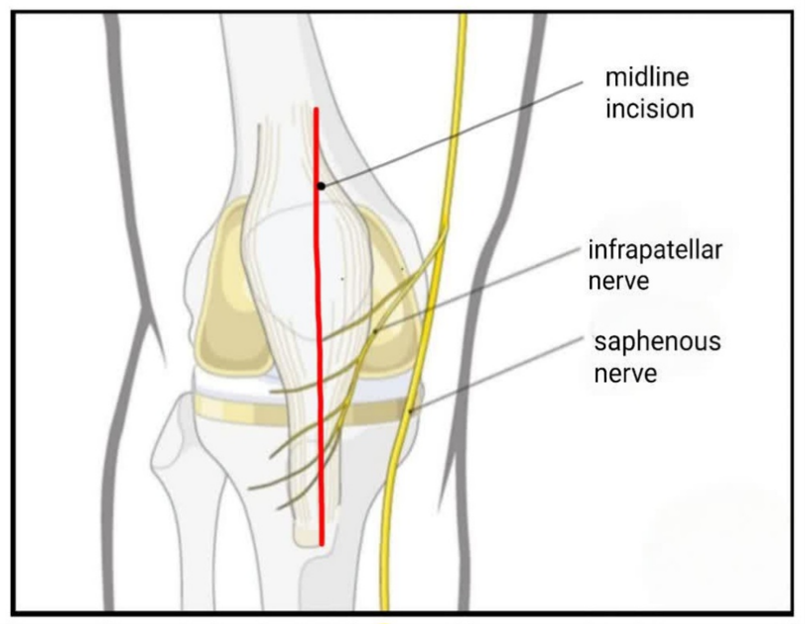
Figure 1. Anterior view of the right knee joint. The IPBSN arises from saphenous nerve and crosses from medial to lateral side below the patella. (Prepared by Authors, 2026).
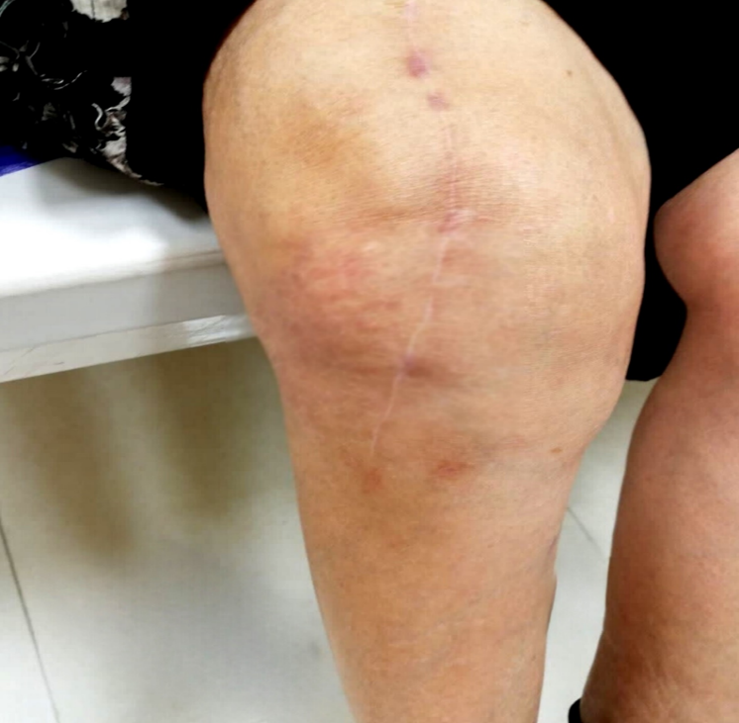
Figure 2. Erythematous scaly plaque with discrete papules lateral to the healed scar of TKA. (Prepared by Authors, 2026).
3. Discussion
SKINTED is an uncommon postoperative neurodermatitis that occurs after knee surgery. Although sensory nerve injury during TKA is widely recognized, subsequent dermatitis localized to the denervated region remains underdiagnosed. The prevalence of the damage to IPBSN during TKA with standard midline surgical incision was reported between 30 to 53 percent in literatures (2,7) but cutaneous eruption is rarely reported at the denervated area (4-15).
SKINTED is a site and procedure specific term that was first proposed by Verma and Mody in 2009 (4). In related literatures, some cases of SKINTED were reported under other terms such as neuropathy dermatitis (5) and autonomic denervation dermatitis (ADD) (6) indicating that these terms can be used for all eczematous eruptions at or around the surgical sites irrespective of the site and nature of the procedure. Indeed, SKINTED is a subset of ADD resulting from injury to dermal nerves (6). These nerves play an integral role in epidermal homeostasis, neuroimmune modulation and barrier regulation. Denervation disrupts neuropeptide release, alters cytokine signaling, reduces microvascular modulation, and increases susceptibility to inflammation (5,6). Experimental studies demonstrate that denervated skin exhibits increased transepidermal water loss, impaired keratinocyte differentiation, and amplified inflammatory responses (4- 6). The incidence of SKINTED was reported as 4.4% (9 cases of 203 TKAs) in Nazeer et al. study (9) and 5.52% (188 cases out of 3318 cases with 4282 TKAs) in Mukartihal et al. study (10). The mean time from TKA to appearance of SKINTED is 4 months (between 2 to 6 months) and is characterized by a pruritic or non-pruritic, scaly erythematous patch or plaque on the lateral side of the TKA scar that resolves between 2 to 6 months (9,10).
Topical corticosteroids and systemic antihistamines constitute first-line therapy, targeting the inflammatory cascade. Resolving of the skin lesion precedes sensory recovery because slower neural regeneration. Persistent hypoesthesia is a recognized outcome in some cases. Recurrence after treatment was uncommon (9, 10).
SKINTED may mimic other postoperative dermatoses including allergic or irritant contact dermatitis, metal hypersensitivity and prosthetic joint infection. Irritant contact dermatitis correlates with exposure to antiseptics and is not restricted to the denervated region. In allergic contact dermatitis often pruritus and eczematous eruptions spread beyond the surgical site, sensation is preserved and patch testing is useful. Metal hypersensitivity may present with bilateral or widespread periarticular dermatitis and is resistant to therapy (16). Prosthetic joint infection is associated with pain, warmth, drainage, fever and elevated inflammatory markers which are absent in SKINTED. The hallmark of SKINTED is its strict topographical localization to the sensory-deficient territory of the injured IPBSN, a feature that strongly supports its neurogenic origin and distinguishes it from other postoperative dermatoses. In our case, the temporal interval between surgery and onset of dermatitis (3 months), the sharply confined dermatitis within an anesthetic zone in lateral side of TKA incision scar, normal laboratory markers, absence of systemic signs, treatment regimen (topical steroid and oral antihistamine), resolving of skin lesion over five weeks, gradual and delayed improvement of sensory loss and no recurrence after treatment were similar to other related studies (4-15).
5. Conclusion
SKINTED is a distinct neurodematitis arising from injury to the infrapatellar branch of the saphenous nerve during TKA. Its characteristic localization to an anesthetic zone, delayed onset and favorable response to treatment differentiate it from other postoperative dermatoses. As TKA volume increases globally, awareness of this condition is essential for dermatologists and orthopedic surgeons as it can prevent unnecessary interventions and optimize postoperative patient care.
6. Declarations
6.1 Acknowledgments
We would like to thank the patient for participation in this case report.
6.2 Ethical Considerations
Not applicable.
6.3 Authors' Contributions
Sayyadinejad A.: Contributed to the study design, data collection, analysis and writing of the manuscript.
Hosein Khani S.: Assisted in data analysis and manuscript drafting.
6.4 Conflict of Interest
The authors declare no conflict of interest to this manuscript.
6.5 Fund or Financial Support
This case report has no funding source.
6.6 Using Artificial Intelligence Tools (AI Tools)
The authors were not utilized AI Tools.
SKINTED is an uncommon postoperative neurodermatitis that occurs after knee surgery. Although sensory nerve injury during TKA is widely recognized, subsequent dermatitis localized to the denervated region remains underdiagnosed. The prevalence of the damage to IPBSN during TKA with standard midline surgical incision was reported between 30 to 53 percent in literatures (2,7) but cutaneous eruption is rarely reported at the denervated area (4-15).
SKINTED is a site and procedure specific term that was first proposed by Verma and Mody in 2009 (4). In related literatures, some cases of SKINTED were reported under other terms such as neuropathy dermatitis (5) and autonomic denervation dermatitis (ADD) (6) indicating that these terms can be used for all eczematous eruptions at or around the surgical sites irrespective of the site and nature of the procedure. Indeed, SKINTED is a subset of ADD resulting from injury to dermal nerves (6). These nerves play an integral role in epidermal homeostasis, neuroimmune modulation and barrier regulation. Denervation disrupts neuropeptide release, alters cytokine signaling, reduces microvascular modulation, and increases susceptibility to inflammation (5,6). Experimental studies demonstrate that denervated skin exhibits increased transepidermal water loss, impaired keratinocyte differentiation, and amplified inflammatory responses (4- 6). The incidence of SKINTED was reported as 4.4% (9 cases of 203 TKAs) in Nazeer et al. study (9) and 5.52% (188 cases out of 3318 cases with 4282 TKAs) in Mukartihal et al. study (10). The mean time from TKA to appearance of SKINTED is 4 months (between 2 to 6 months) and is characterized by a pruritic or non-pruritic, scaly erythematous patch or plaque on the lateral side of the TKA scar that resolves between 2 to 6 months (9,10).
Topical corticosteroids and systemic antihistamines constitute first-line therapy, targeting the inflammatory cascade. Resolving of the skin lesion precedes sensory recovery because slower neural regeneration. Persistent hypoesthesia is a recognized outcome in some cases. Recurrence after treatment was uncommon (9, 10).
SKINTED may mimic other postoperative dermatoses including allergic or irritant contact dermatitis, metal hypersensitivity and prosthetic joint infection. Irritant contact dermatitis correlates with exposure to antiseptics and is not restricted to the denervated region. In allergic contact dermatitis often pruritus and eczematous eruptions spread beyond the surgical site, sensation is preserved and patch testing is useful. Metal hypersensitivity may present with bilateral or widespread periarticular dermatitis and is resistant to therapy (16). Prosthetic joint infection is associated with pain, warmth, drainage, fever and elevated inflammatory markers which are absent in SKINTED. The hallmark of SKINTED is its strict topographical localization to the sensory-deficient territory of the injured IPBSN, a feature that strongly supports its neurogenic origin and distinguishes it from other postoperative dermatoses. In our case, the temporal interval between surgery and onset of dermatitis (3 months), the sharply confined dermatitis within an anesthetic zone in lateral side of TKA incision scar, normal laboratory markers, absence of systemic signs, treatment regimen (topical steroid and oral antihistamine), resolving of skin lesion over five weeks, gradual and delayed improvement of sensory loss and no recurrence after treatment were similar to other related studies (4-15).
5. Conclusion
SKINTED is a distinct neurodematitis arising from injury to the infrapatellar branch of the saphenous nerve during TKA. Its characteristic localization to an anesthetic zone, delayed onset and favorable response to treatment differentiate it from other postoperative dermatoses. As TKA volume increases globally, awareness of this condition is essential for dermatologists and orthopedic surgeons as it can prevent unnecessary interventions and optimize postoperative patient care.
6. Declarations
6.1 Acknowledgments
We would like to thank the patient for participation in this case report.
6.2 Ethical Considerations
Not applicable.
6.3 Authors' Contributions
Sayyadinejad A.: Contributed to the study design, data collection, analysis and writing of the manuscript.
Hosein Khani S.: Assisted in data analysis and manuscript drafting.
6.4 Conflict of Interest
The authors declare no conflict of interest to this manuscript.
6.5 Fund or Financial Support
This case report has no funding source.
6.6 Using Artificial Intelligence Tools (AI Tools)
The authors were not utilized AI Tools.
Type of Study: Case Report Article |
Subject:
Clinical Medicine
Received: 2026/03/20 | Accepted: 2026/05/26 | Published: 2026/08/4
Received: 2026/03/20 | Accepted: 2026/05/26 | Published: 2026/08/4
References
1. Sanna M, Sanna C, Caputo F, Piu G, Salvi M. Surgical approaches in total knee arthroplasty. Joints. 2013;1(2):34.
2. Ackmann T, Von Düring M, Teske W, Ackermann O, Muller P, Von Schulze Pellengahr C. Anatomy of the infrapatellar branch in relation to skin incisions and as the basis to treat neuropathic pain by cryodenervation. Pain Physician. 2014;17(3):E339-48. [DOI:10.36076/ppj.2014/17/E339]
3. Kerver AL, Leliveld MS, den Hartog D, Verhofstad MH, Kleinrensink GJ. The surgical anatomy of the infrapatellar branch of the saphenous nerve in relation to incisions for anteromedial knee surgery. J Bone Joint Surg Am. 2013;95(23):2119-25. [DOI:10.2106/JBJS.L.01297] [PMID]
4. Verma SB, Mody BS. Explaining a hitherto nameless condition: 'SKINTED'. Clin Exp Dermatol. 2009;34(7):e465. [DOI:10.1111/j.1365-2230.2009.03522.x] [PMID]
5. Sharquie KE, Noaimi AA, Alaboudi AS. Neuropathy dermatitis following surgical nerve injury. Case Rep Dermatol Med. 2011;2011:234185. [DOI:10.1155/2011/234185] [PMID] [PMCID]
6. Bhushan M, Madhulika M, Piyush K, Adarsh Lal S, Anil P. Autonomic denervation dermatitis: A new type of eczematous dermatitis. Clin Dermatol Rev.2017; 1(2): 61- 64. [DOI:10.4103/CDR.CDR_8_17]
7. Jariwala AC, Parthasarathy A, Kiran M, Johnston LR, Rowley DI. Numbness around the total knee arthroplasty surgical scar: prevalence and effect on functional outcome. J Arthroplast. 2017;32(7):2256-61. [DOI:10.1016/j.arth.2017.01.057] [PMID]
8. Satku K, Fong PH, Kumar VP, Lee YS. Dermatitis complicating operatively induced anesthetic regions around the knee. A report of four cases. J Bone Joint Surg Am. 1993;75(1):116. [DOI:10.2106/00004623-199301000-00015] [PMID]
9. Nazeer M, Ravindran R, Katragadda BC, Muhammed EN, Rema DTJ, Muhammed MN. SKINTED: A rare complication after total knee arthroplasty. Arthroplast Today. 2020; 20;6(4):1028-32. [DOI:10.1016/j.artd.2020.10.004] [PMID] [PMCID]
10. Mukartihal R, Rajnish RK, Patowary P, Biswal UK, Ramesh PA, Patil SS. Neuropathy dermatitis: An under documented complication following total knee arthroplasty. Indian J Orthop. 2023;57(3):445-52. [DOI:10.1007/s43465-023-00835-4] [PMID] [PMCID]
11. Mahajan VK, Sharma V, Sharma N, Rani R, Chandel M. SKINTED: an uncommon cutaneous complication of total knee replacement. Am J Neurodegener Dis. 2023; 25;12(1):16-22.
12. Sekar M. Arriving at SKINTED (Surgery of the Knee, Injury to the Infrapatellar Branch of the Saphenous Nerve, Traumatic Eczematous Dermatitis): A Case Report. Cureus. 2024;16;16(2):e54307. [DOI:10.7759/cureus.54307]
13. Kalgi B, Drumil M, Raval P, Ranjan C, Malhar Sh. What is in a name? Demystifying "SKINTED"-A review of literature from dermatological perspective. Turk J Dermatol.2023; 17(1): 1-5. [DOI:10.4103/tjd.tjd_113_22]
14. Jolkovsky E, Zeegen E, Ahronowitz I. Eczematous neurodermatitis following total knee arthroplasty: expanding awareness of a rare and underdiagnosed postoperative dermatologic complication. Cureus. 2025;17(6): e86989. [DOI:10.7759/cureus.86989] [PMID] [PMCID]
15. Tyagi S, Sihag Y. Bilaterally symmetrical SKINTED: A rare entity. Cosmo Derma. 2025;5: 97. [DOI:10.25259/CSDM_115_2025]
16. Saccomanno MF, Sircana G, Masci G, Cazzato G, Florio M, Capasso L, et al. Allergy in total knee replacement surgery: is it a real problem? W J Orthopedics. 2019;10(2):63-70. [DOI:10.5312/wjo.v10.i2.63] [PMID] [PMCID]
Send email to the article author
| Rights and permissions | |
 |
This work is licensed under a Creative Commons Attribution-NonCommercial 4.0 International License. |
Copyright Policy
Journal of Advances in Medical and Biomedical Research by Zanjan University of Medical Sciences is licensed under CC BY-NC 4.0